
I have sat in a lot of sales meetings where someone says they know who their ideal customer is. Then they describe a company that’s so general it could be almost any business on LinkedIn. Everyone in the meeting nods in agreement. Writes it down. That is not an ideal customer profile. It is a wish list.
I understand why this happens. When you are running a business or building a sales team it can feel risky to narrow down your focus. You might think that if you define your customer too closely you will miss out on other potential customers. So instead of being specific you keep the definition vague. This approach does not work.
When your ideal customer profile is too broad your sales targeting is off. You are not reaching the right people. Your messaging sounds generic because it is generic. You cannot personalize your approach for someone you have not actually defined. Your sales team spends a lot of time chasing prospects who were never going to buy from you. They run demos with companies that are a bad fit and write follow-up sequences for deals that die quickly.
All of these problems come from not having a real ideal customer profile. Building a proper ideal customer profile is one of the most important things you can do for your sales team. It is a strategic exercise. Most teams do not have one and do not realize it. They think they have a customer profile but they do not.
So What Is an Ideal Customer Profile?
It is a description of the type of company that gets the most value from what you sell, is most likely to buy from you, and is most likely to stay a customer. It is about the company, not the person. It describes the company’s characteristics, such as industry, size, location and technology. It is not about the buyer persona or the personality traits of the person you are trying to reach.
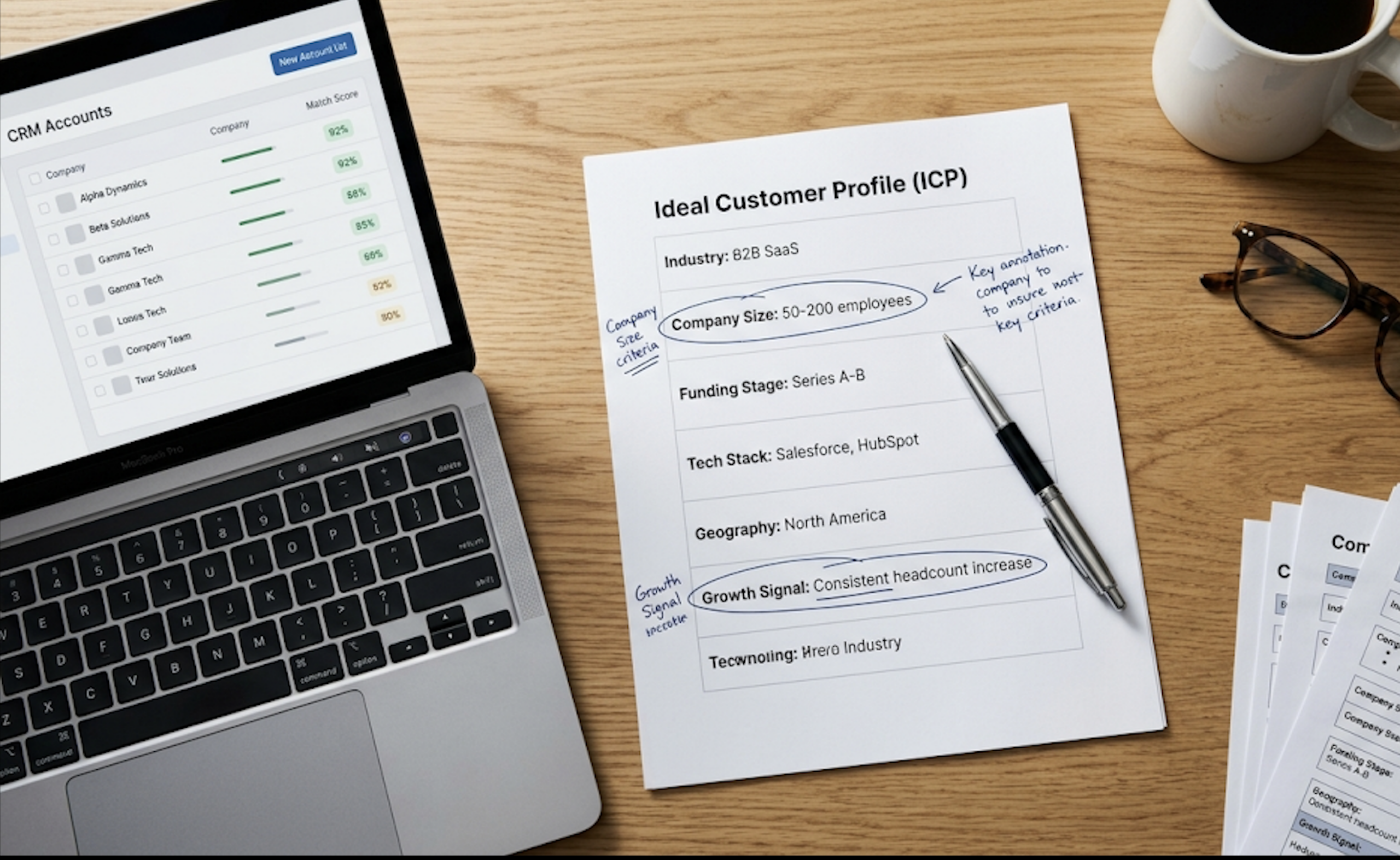
A strong ideal customer profile includes things like industry, company size, geography, technology, business model and funding stage. It is specific and detailed. It should tell you immediately whether a new company is worth pursuing or not. If it cannot do that, it is not specific enough.
Your ideal customer profile is not who you want to sell to. It is who actually buys from you and succeeds with your product. Those two groups are not always the same. You might want to sell to enterprise companies, but your actual best customers might be small startups. You have to be honest about which one is real and build your ideal customer profile around that reality.
Most Teams Get This Wrong
They write down a range like “mid-market companies in the technology space” and call it an ideal customer profile. That is not an ideal customer profile. It is a demographic range. There are probably thousands of companies that fit that description.
Another mistake teams make is building an aspirational ideal customer profile. They look at the logos they want to land and build their ideal customer profile around those companies. That is not realistic. They are targeting the wrong companies and wondering why their outbound sales targeting is not working.
The third mistake teams make is having an outdated ideal customer profile. They built one a long time ago but it is no longer relevant. The market has shifted. New customer types have emerged. They have not updated their ideal customer profile to reflect those changes.
How to Build One That Actually Works
To build a customer profile that actually works you need to start with your existing customers. Look at your best customers, the ones that closed quickly and had few objections. Find what they have in common. Look at their industry, company size, technology and geography. This kind of customer segmentation is where the patterns start to emerge. Use that information to build your ideal customer profile.
It takes time and effort to build an ideal customer profile. It is worth it. It will help you target the right companies and personalize your approach. You will spend less time chasing prospects who are not a good fit and more time closing deals with companies that are a good match for your product.
Look at your customers and find what they have in common. Identify the patterns in their industry, company size, technology and geography. Use that information to build your customer profile. Be honest about who your real customers are and build your ideal customer profile around that reality. Update your customer profile regularly to reflect changes in the market and your customers.
Leadership and Decision-Making
Customer accounts are really important. You need to know if there is a VP of Sales who really likes your product. Maybe a founder who got involved at the end of the deal. A RevOps lead who made the final decision. Understanding how customer accounts work helps you know what kind of company to look for when you are trying to sell to new customers.
When you figure all of this out you will start to see a picture of what your best customer looks like. This picture is the foundation of your Ideal Customer Profile, or ICP for short.
The Signals That Make Your ICP Come Alive
I think about this a lot. A static ICP tells you what to look for in a customer. The market is always changing. Companies change, leadership changes, and teams get built and rebuilt. A company that was not a fit for you a year ago might be a great fit now.
This is where buyer intent signals come in. Most teams define their ICP. Then make a list of companies that fit the description. This list is just a snapshot. It does not tell you which companies are ready to talk to you right now.
Real sales intelligence means layering signals on top of your ICP framework. Which companies in your target market just got funding. Which ones just hired a VP of Sales. Which ones are posting job descriptions that suggest they need your product.
When you combine an ICP with live intent signals, your sales targeting gets a lot better. You are not just sending emails to a list of companies. Your sales prospecting becomes sharper and you are reaching the right company at the right time.
The Role of AI Targeting in Modern ICP Work
I want to be clear about this. Building and using an ICP used to be a manual process. You defined the criteria, someone made a list, and your team worked through it. This process is slow and outdated.
AI targeting changes how this works. Instead of relying on a static list, AI-powered prospecting tools look at the market for accounts that match your ICP criteria and flag the ones that are ready for a conversation.
This is what ReachIQ’s AI targeting does. You define your ICP and the system finds accounts that match it in real time. It prioritizes accounts based on signals that suggest they are ready to talk, not just based on the company profile.
The practical effect of this is that your team spends time on accounts that are actually ready to talk, not just accounts that look good on paper.
When you combine a defined ICP with AI-powered prospecting, you are not just reaching more companies. You are reaching the right companies at the right time with context about why they are a good fit and what is happening in their business right now.
Turning an ICP Into Messaging That Actually Lands
This is where the ICP really pays off. Once you know who you are talking to, your messaging gets a lot sharper. You stop writing generic emails and start writing emails that feel like they were written for this specific company.
Real hyper-personalization means demonstrating that you understand the world this person operates in. Their company stage, team structure, and the pressure they are under. You can only do that when your ICP is specific enough to give you that understanding.
A Series A SaaS company with fifteen sales reps and a new VP of Sales has different problems from a bootstrapped 200-person company with a mature sales team. Your outreach needs to reflect those differences.
The ICP is not just a targeting document. It is also a messaging document. It tells you what to say, what problems to reference and what language to use.
Your ICP Is Not a One-Time Exercise
This is the part that most teams get wrong. They treat the ICP like a project, not a living document. They build it, put it in a doc and move on.
Six months later the market has shifted and the product has evolved. New customer types have started showing up in the pipeline. The ICP needs to be updated.
A good idea is to revisit your ICP every quarter. Pull your recent closed deals and compare them to the current ICP. Talk to your customers and ask them what made them decide to buy.
The teams with the sharpest sales targeting are the ones who treat ICP as an ongoing process, not a one-time project. They are constantly refining based on data.
What a Real ICP Looks Like Compared to a Weak One
I want to make this clear. A weak ICP is something like “we sell to mid-market B2B companies with a sales team.”
A real ICP is something like “we sell to Series A and Series B SaaS companies between 50 and 200 employees with an outbound sales team of at least five reps using Salesforce as their primary CRM and showing consistent headcount growth over the past year.”
The difference is huge. A real ICP is a filter that helps you identify the right companies. When your ICP is that specific, everything downstream improves. Your account-based outreach is sharper, your prospect qualification is faster, and your sales team stops wasting time on companies that are not a good fit.
Common Mistakes to Avoid When Building Your ICP
One common mistake is building the ICP alone. Your ICP should not live in the head of one person, nor be built by one team. You need input from your sales team, customer success team and marketing team.
Another mistake is skipping customer interviews. You need to talk to your customers and ask them what made them decide to buy. This will give you a lot of information that you can use to improve your ICP.
A lot of teams only do desk research for their Ideal Customer Profile. They look at their customer relationship management system, pull the numbers, and write the Ideal Customer Profile based on the data. That is better than nothing.
The real gold is in the conversations with your Ideal Customer. When you actually talk to your customers and ask them why they bought your product, what problem they were solving, and what made you the right fit for them, you learn things that no amount of spreadsheet analysis will tell you. You should make the calls to your Ideal Customer.
Defining company size only by the number of employees is not a good idea. The number of employees is just one piece of information. It misses a lot of important things. Two companies with the same number of employees can be in completely different stages with different budgets, different urgency levels and different buying behaviors.
The revenue range, funding stage and growth trajectory of a company give you a more complete picture of whether a company is actually the right fit for your business and your Ideal Customer Profile.
Not sharing your Ideal Customer Profile with the team is a mistake. An Ideal Customer Profile that only lives with the leadership or the strategy team does not help anyone.
Your sales team needs to know what your Ideal Customer is. Your account executives need to know what your Ideal Customer is. Your marketing team needs to know what your Ideal Customer is. Everyone who touches the customer-facing part of your business should know who your Ideal Customer is and why they are your Ideal Customer.
Treating your Ideal Customer Profile as something that never changes is not a good idea. Markets change. Products evolve. The type of customers you have will shift. Your Ideal Customer Profile should evolve with them. You should build in a regular review of your Ideal Customer Profile and stick to it.
Where to Start Today
If you have been in business for a while and you have customer data, start there.
Pull your ten best accounts from the last 18 months. Define what “best accounts” means for your business, whether that is the accounts that closed the fastest, the accounts with the most revenue, the accounts with the best retention, the accounts with the most referrals, or some combination of these things.
Then go through each account. Document everything you can find about them. The industry they are in, the size of the company, the funding stage, the technology they use, the team structure, the location, who the champion was, and what triggered the deal.
When you have done that for ten accounts, look for the patterns. The things that show up consistently are the building blocks of your Ideal Customer Profile.
If you are early stage and you do not have enough customer data yet, start with a hypothesis. Think about who you built your product for, who has the most acute version of the problem you solve, and who has the means and authority to actually buy your product.
Build a hypothesis, run outbound sales efforts against it, and treat every conversation as data. Refine your Ideal Customer Profile as you go.
Either way, the goal is the same. A description of your Ideal Customer that is specific enough to act on, honest enough to reflect reality, and detailed enough to inform your targeting, your messaging and every decision your sales team makes as part of a broader B2B sales strategy.
At ReachIQ, the Ideal Customer Profile is the thing we build with every client. Before we write a sequence, before we identify a single account, before we send a single message, we get the Ideal Customer Profile right. It is the foundation of every outbound sales strategy we build.
Because if that foundation is off, nothing else works. When it is right, everything else gets dramatically easier.
The AI targeting we use does not just match companies to a checklist. It finds accounts that fit your Ideal Customer Profile and are showing signals of readiness right now. It is the difference between a list and a targeting system that keeps your pipeline full of accounts that are actually worth pursuing.
If you want to see what that looks like for your business and your specific Ideal Customer Profile, book a demo. We will walk you through how it works and what the output looks like for companies in your space.