
I want to tell you something that most sales leaders already know but do not want to say out loud. The way B2B sales prospecting has been done for the last ten years is broken. I do not mean slightly inefficient or could use some improvement. I mean fundamentally broken in a way that wastes massive amounts of time, burns through budget, and frustrates every single person involved. From the SDR grinding through lists at 7am to the VP staring at pipeline numbers wondering why nothing is moving.
Think about what a typical day looks like for someone on your sales team right now. They spend the first hour or two building lists. Pulling names from LinkedIn. Cross-referencing against a database that was probably last updated months ago. Guessing at email addresses. Hoping the verification tool catches the bad ones. Then they write outreach messages that, if we are being honest with ourselves, are basically the same template with a few fields swapped. Company name here. First name there. Maybe a line about a funding round if they have time.
They send a hundred or two hundred of those. Maybe get two replies. Maybe three on a good day. Then they do the whole thing again tomorrow.
AI sales prospecting is changing that workflow from the ground up. Not in a theoretical kind of way. Right now. And the gap between teams using AI sales prospecting and teams still grinding through the manual process is getting wider every month. I am watching it happen in real time and honestly the difference in output between these two groups is hard to believe until you see the numbers.
So let us talk about what’s actually different. What intelligent prospecting looks like when it is done right. And why B2B sales prospecting is never going back to how it used to work.
The Old Way of Prospecting Is Dying (And It Should)
I have to be direct about this because I think some people still do not realize how much the landscape has shifted underneath them. Traditional sales prospecting strategy looks something like this. You buy a list from a data provider. Or you build one manually, which takes forever. You load it into your outreach tool. You write a sequence of three to five emails that sound like every other cold email sitting in your prospect’s inbox. You hit send. You wait. You follow up with the people who already ignored you. You get ignored again. Repeat.
The problem is not that sales reps are bad at their jobs. Most of them are working incredibly hard. I have a lot of respect for SDRs because the role is genuinely difficult. The problem is that this entire method treats every prospect the same way. Same message. Same timing. Same channel. No intelligence behind any of it. You are playing a numbers game and hoping that if you blast enough volume, some tiny percentage will happen to land at the right moment with the right person who happens to be thinking about buying.
That worked ten years ago when inboxes were less crowded and buyers had fewer options to choose from. It does not work now. Decision makers at B2B companies are getting hit with dozens of cold outreach messages every day. Emails. LinkedIn messages. Phone calls. Direct mail. The noise is deafening and buyers have gotten extremely good at ignoring all of it. If your message sounds like everyone else’s, it goes to the delete folder without a second thought. Every single time.
Here is what I think most teams completely miss about this. The cost of bad prospecting is not just the low reply rates. It is the opportunity cost. Every hour an SDR spends researching the wrong accounts or writing generic emails to people who were never going to buy is an hour they could have spent having a real conversation with someone who was actually ready to talk. That math adds up fast. Over a quarter you are talking about hundreds of hours of wasted capacity across a team.
This is not a channel problem. This is not an email problem. This is an intelligence problem. That is exactly what AI sales prospecting is solving.
What AI Sales Prospecting Actually Means
I want to be specific because AI gets thrown around so loosely in sales conversations that it has basically lost all meaning. Every tool on the market claims to have AI. Most of them just mean they automated something and slapped a machine learning label on the marketing page.
When I talk about AI sales prospecting I am not talking about chatbots. I am not talking about auto-generated subject lines. I am not talking about a tool that sends emails faster. I am talking about a fundamentally different approach to finding, prioritizing, and engaging potential customers. One that uses machine learning to make prospecting smarter. Not louder. Smarter.
AI Lead Generation: Finding the Right People
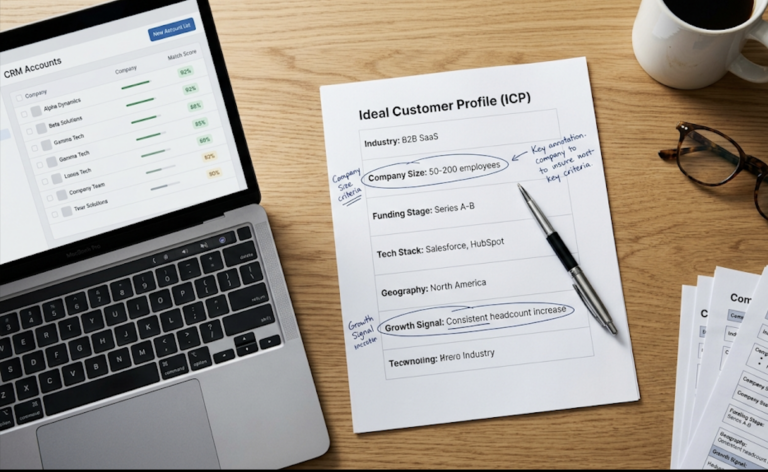
Traditional list building starts with firmographic filters. Industry. Company size. Job title. Location. You plug those into a database. Out comes a list of people who could theoretically be your customers. That list tells you absolutely nothing about who is actually likely to buy right now versus who will not be ready for another two years.
AI lead generation changes this by adding intelligence layers on top of those basic filters. Machine learning models can analyze patterns across thousands of your won and closed-lost deals to identify which specific combination of attributes actually predicts conversion. Not just firmographics. Behavioral signals, technographic indicators like what tools they are currently using, funding events, hiring patterns that suggest expansion, content engagement signals, and B2B buyer intent data that shows who is actively researching solutions in your category.
The result is not just a list. It is an intelligent one. Instead of starting with ten thousand contacts and hoping fifty are relevant, you start with five hundred that your model has identified as genuinely likely to be in market right now. Your sales team stops wasting time on dead ends and starts spending energy on prospects who have an actual reason to talk to them.
I have seen teams cut their prospect list by 80 percent and double their pipeline output. Not because they worked harder. Because they finally worked on the right accounts.
Lead Scoring AI: Knowing Who to Call First
Once you have your list the next question is where to start. You have five hundred prospects. Which fifty deserve attention this week? Traditional lead scoring tries to answer this with rules that someone on the marketing team wrote two years ago and never updated. Downloaded a whitepaper? Ten points. Visited the pricing page? Twenty points. VP level title? Fifteen points.
The problem is these rules are arbitrary and they never adapt to reality. What if your best customers never download whitepapers? What if job title matters ten times more than page visits for your product? Static rules cannot figure that out. They just keep scoring the same way regardless of what is actually happening in your pipeline.
Lead scoring AI uses machine learning to figure out which behaviors and attributes actually correlate with conversion for your specific business. Not some generic model built on someone else’s data. A model that learns from your wins and losses. It identifies the patterns and scores new leads accordingly. It updates continuously as new data comes in so the scoring gets sharper over time instead of going stale.
This matters more than most people think. The difference between reaching a lead within an hour of them showing intent versus reaching out three days later when they have already talked to two competitors is massive. I have seen response rates drop by half or more when outreach is delayed by a single day. Lead scoring AI makes sure your highest potential prospects get attention first. While they are still warm. Not after the window has closed.
Predictive Lead Generation: Finding Buyers Before They Find You
Now here is where I think the most value actually lives and where things get genuinely exciting. Predictive lead generation goes beyond scoring leads that are already in your system. It goes out and finds companies and contacts that match your ideal customer profile and are showing early buying signals, even before they have ever heard of your brand.
Machine learning models can analyze patterns across millions of data points to spot companies in the early stages of a buying cycle. They might be researching your category on review sites. Hiring for roles that typically come before a purchase. Increasing spend in related areas. Showing digital footprints that individually mean nothing but together form a strong signal that they are moving toward a decision.
That is the difference between sitting around waiting for inbound leads that may or may not be any good and proactively getting in front of the right accounts at exactly the right moment. For B2B sales teams this changes everything about how pipeline gets built.
The timing advantage is really important. If you reach a prospect when they are just starting to explore options, you position yourself as the first solution they evaluate. You get to frame the conversation. You set the buying criteria. By the time competitors show up, the prospect is already comparing everything against you. This positioning advantage is hard to overstate. And it comes directly from getting there first.
AI Targeting: Reaching the Right Person With the Right Message
Finding the right people is only half the battle. The other half is actually getting their attention once you have found them. AI targeting is about making every touchpoint relevant, personal, and well-timed so it cuts through the noise instead of adding to it.
Hyper-Personalization at Scale
Here is the problem that has always existed in outbound sales and honestly I do not think anyone solved it properly until AI came along. Personalized outreach works better than generic outreach. Everyone in sales knows this. A thoughtful message that references something specific about the prospect’s business will outperform a cookie-cutter template every time. Nobody disputes this.
But real personalization takes time. A good sales development representative who actually puts in the research might write truly personalized emails for maybe 20 to 30 prospects per day. That is the ceiling. At that volume you cannot build enough pipeline to hit serious revenue targets. So teams have always faced a choice. Go deep and sacrifice volume. Go high volume and sacrifice quality. Both options have serious problems.
Hyper-personalization powered by AI eliminates that tradeoff entirely. It generates genuinely personalized messaging for every single prospect automatically. I need to be clear about what I mean here because a lot of people confuse this with mail merge. Inserting a name and company name into a template is not personalization. That is a trick from 2015. What I am talking about is actually crafting messages that reference recent news about their company, their role and the challenges that come with it, competitive dynamics in their industry, and what makes their situation genuinely different from the next person on the list.
AI models pull from company news, job postings, financial data, tech stack information, social activity, and dozens of other sources to create outreach that feels like someone spent twenty minutes researching that specific prospect. Except it was generated in seconds. And it can do that for every single prospect in your pipeline.
The result is outreach that gets the response rates of hand-crafted personalization at the volume of automated sequences. That is the unlock that completely changes the economics of outbound sales. And it is happening right now.
Multi-Channel Prospecting
This is something I feel strongly about. I have talked about it before. If your entire sales prospecting strategy is built around a single channel, and that channel is usually email, you are leaving a massive amount of pipeline on the table. Full stop.
Multi-channel prospecting means reaching your targets across email, LinkedIn, phone, and potentially other channels in a coordinated, intelligent sequence. Not randomly pinging people on different platforms hoping something sticks. Coordinating it so each touchpoint builds on the last and the overall sequence feels intentional. Like you actually put thought into it.
AI makes multi-channel prospecting manageable at scale. Without AI, trying to run multi-channel sequences for hundreds of prospects simultaneously is an operational nightmare. You lose track of who got what on which channel. Follow-ups get missed constantly. Things fall through the cracks. It is chaos.
With AI, the system orchestrates everything automatically. It knows which channel each prospect is most likely to respond on based on their behavior patterns. It adjusts the sequence in real time based on engagement. Someone opens your email but does not reply? The AI follows up on LinkedIn the next day. They engage on LinkedIn but do not book? Phone call gets triggered. Every touchpoint is informed by what happened before it.
Cold email outreach is still important within this mix. I am not saying stop emailing people. But email is one channel, not the only channel. AI ensures your cold emails are personalized, well-timed, and reinforced by touchpoints on other channels that create the feeling of a real coordinated outreach effort. Not random spam from multiple directions.
Account-Based Selling With AI
Account-based selling has been a B2B strategy for years and the logic behind it makes total sense. Focus your resources on high-value target accounts rather than spraying outreach everywhere. Concentrate your efforts where the biggest deals live. Smart strategy.
The problem has always been execution. Doing account-based selling properly requires an enormous amount of work. Identify the right accounts. Map all the stakeholders. Understand each person’s role and perspective. Write custom outreach for each of them that speaks to their specific concerns. Coordinate the timing so multiple people at the same company are being engaged in a way that feels deliberate. Track everything. Adjust based on results.
Most teams try it and end up doing it halfway. They execute well on their top five or ten accounts and default to generic mass outreach for everything else. Which basically defeats the purpose.
AI changes this by automating the research, mapping, and personalization layers. It identifies which accounts match your ideal profile and are showing buying signals. Maps the stakeholders automatically. Generates personalized outreach for each one based on their role and seniority. Coordinates the sequence so the CTO, the VP of Sales, and the Director of Operations are all being engaged simultaneously with messages that actually make sense for each of them.
That is account-based selling the way it was always supposed to work. Not limited to your top ten accounts. Scalable across hundreds of them at once. Completely different level of execution.
The AI SDR: What It Is and What It Is Not
I want to address this head on because there is a lot of noise around this topic. Some vendors are claiming AI can fully replace human sales development representatives. I think that is oversimplified and in many cases flat out misleading.
What an AI SDR does well is handle the repetitive, time-consuming parts of the job. List building. Research. Initial outreach drafting. Follow-up sequences. Meeting scheduling. Data entry into the CRM. These tasks eat up the majority of a human SDR’s day but they do not require human judgment, emotional intelligence, or the ability to read a room.
What an AI SDR does not do well yet is handle live objections in a real conversation, build genuine rapport with a skeptical buyer, navigate the political dynamics inside a target account, or make the kind of nuanced judgment call about whether someone is actually a fit that goes beyond what any data model can capture.
The smartest teams I have seen are using AI SDR tools to amplify their humans, not replace them. The AI handles prospecting, personalization, and sequencing. Does in four minutes what used to take four hours. The human steps in when it matters. When a prospect replies. When there is a meeting. When objections need handling with empathy and real judgment.
Each human SDR ends up covering the territory of three or four people. Not by doing more grunt work. By doing more of the work that actually moves deals forward. That is the right model.
Outbound Sales Automation: The Line Between Helpful and Annoying
I need to talk about this because I think the industry is at a crossroads right now. Outbound sales automation has gotten incredibly powerful. AI sales tools can identify prospects, write messages, deploy multi-channel sequences, and book meetings with barely any human involvement.
But powerful automation without good judgment just creates spam at scale. And there is already too much spam in B2B outreach. We have all experienced it. Emails that are obviously mass-sent with a thin veneer of personalization that fools nobody. LinkedIn messages that are clearly automated. Follow-up sequences that keep hammering away regardless of whether you have shown any interest.
The difference between well-executed AI-powered outreach and annoying spam is not the technology. It is the strategy behind it.
Good outbound sales automation means reaching relevant prospects with genuinely relevant messages at genuinely relevant times. It means using B2B buyer intent data to make sure you are only reaching people who are in a position to benefit from what you sell. It means respecting their time even while operating at scale.
Bad outbound sales automation means blasting every contact in your database because the AI made it easy to send high volume. That is not prospecting. That is pollution. It damages your brand, your domain reputation, and honestly the entire ecosystem.
The companies that win here are the ones using AI sales tools to increase relevance, not just throughput. Fewer total messages. More targeted. Better timed. Higher reply rates. More meetings. Better pipeline. That is the formula.
How ReachIQ Puts This Together
I am biased. I want to be upfront about that. But walking through a real example shows how these pieces actually fit together instead of staying theoretical.
ReachIQ is a sales intelligence platform that combines AI targeting, predictive lead generation, hyper-personalization, and multi-channel prospecting in one system. Not four separate tools stitched together with API connections. One platform handling the entire prospecting workflow.
Here is what it looks like in practice. The AI analyzes your historical deal data and builds a model specific to your business. What industries convert. What company sizes. What titles. What tech stacks. What signals showed up before your best deals closed.
It uses that model to continuously find new prospects matching your ideal profile who are showing buying signals right now. Not last quarter. Now.
For each prospect it generates personalized outreach based on their specific context. Real personalization. Their company, their role, their situation, and why the timing makes sense for them specifically.
It deploys that outreach across email, LinkedIn, and phone in a coordinated multi-channel sequence, timed based on what the data shows works best for that type of prospect.
And it learns continuously. Which messages get replies. Which channels work for which segments. What time of day gets the highest engagement. The system gets smarter over time instead of staying static.
Your sales development representatives stop spending hours on lists and templates. They spend their time talking to people who have already been identified, reached, and warmed up by the system. That is the shift from manual prospecting to intelligent prospecting. And it is happening right now.
Where B2B Sales Prospecting Is Headed
I am going to keep this simple because predictions in sales technology rarely age well. Every year someone says cold calling is dead or email is dead or SDRs are dead and every year those things keep working for teams that do them well. So I will not make dramatic predictions.
But a few things seem clear.
The data available for B2B sales prospecting is only going to increase. More intent signals. More behavioral data. More technographic information. AI models will keep getting better at identifying who is ready to buy. The companies that invest in their data infrastructure and AI capabilities now will have a compounding advantage that gets harder to catch up to over time.
The tool stack is going to consolidate. Most teams are currently using five to ten different tools for list building, enrichment, sequencing, analytics, and CRM management. AI is going to collapse those into integrated platforms that handle the full workflow. One system from identification to outreach to booking. The current fragmented approach is not sustainable.
The bar for outreach quality will keep rising. As more teams adopt AI-powered outreach, the baseline quality of prospecting messages will go up across the board. Teams still sending generic templates will fall further and further behind. Intelligent prospecting will not be a competitive advantage forever. Eventually it will just be table stakes.
The SDR role will evolve. Less time on manual tasks. More time on conversations with qualified prospects. The SDRs who thrive will be the ones who are great at the human parts. Empathy. Creativity. Relationship building. Strategic thinking. The mechanical work will be handled by AI.
What This Means for Your Team Right Now
If you are running a B2B sales team, here is what I would tell you.
The window to adopt AI sales prospecting while it still gives you a meaningful competitive advantage is closing. Not tomorrow. But sooner than most people think. Every month more competitors make the switch from manual to intelligent prospecting and the early-mover advantage gets smaller.
Look at how your team spends their time right now. If more than half their day goes to list building, research, email writing, and manual follow-up, you have a massive efficiency opportunity sitting right in front of you. That is time AI can reclaim and redirect toward work that actually moves pipeline.
Evaluate your current tools honestly. Are they helping your team prospect smarter or just faster? Sending more emails is not the same as sending better emails to better prospects. If your tools are optimized for volume but not intelligence, you have a tools problem.
Think about your data. Do you have historical deal data that a machine learning model can learn from? Do you have visibility into prospect behavior before they talk to sales? If not, start building that foundation now. AI is only as good as what it learns from.
And if you want to see what all of this looks like as a single integrated platform that actually works, that is what ReachIQ does. AI targeting. Predictive lead generation. Hyper-personalization. Multi-channel prospecting. One system. Book a demo and see for yourself.